You're done with your shift. Your back's sore, your knees are thrashed, and you've got another identical day coming tomorrow. You've heard about cold plunges and ice baths — recovery methods that guys like you actually swear by. But they're not the same thing, and picking the wrong one could mean wasting time (and money) on recovery that doesn't actually work for your situation.
Here's the straight answer: cold plunges and ice baths both reduce soreness and speed recovery, but they work differently. Temperature, consistency, and what you're recovering from — that's where the difference lives.
This is what you need to know to pick the right recovery tool for your body and your job.
The Real Difference: Temperature and Consistency
Ice Bath
An ice bath is the DIY option. You fill a tub with water, dump in ice, and sit. Temperature range: 35–55°F (2–13°C). The problem? Temperature isn't stable. As soon as you add the ice, it starts melting. The first 5 minutes might be painfully cold. By minute 15, you're basically in cool water. Each session is different.
Cold Plunge
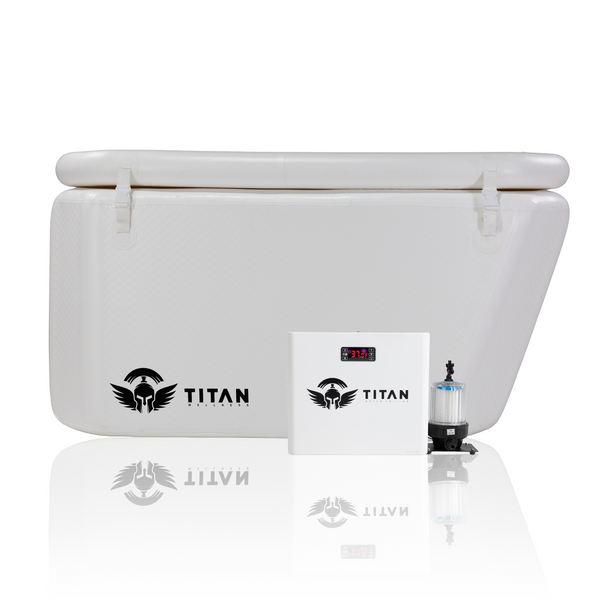
A cold plunge is engineered equipment — a tub with a built-in chiller. It maintains a precise temperature consistently: 50–59°F (10–15°C). You sit down, the temperature stays the same for the entire session, and you get the exact same recovery stimulus every single time.
Your body adapts to what you expose it to. When temperature bounces all over the place, your nervous system doesn't know what to expect. You can't build real cold tolerance, and you can't measure whether recovery is actually improving. A cold plunge removes that guesswork entirely.
Which One Actually Works Better for Recovery?
Both methods work. The research on cold water immersion — including the landmark Cochrane systematic review — confirms that cold water immersion is significantly more effective than passive rest for reducing delayed onset muscle soreness (DOMS). Here's how the two methods differ in practice:
Ice Bath: Fast Inflammation Control
Ice baths hit harder. Colder water triggers stronger vasoconstriction — your blood vessels tighten up, swelling goes down fast, and muscle soreness drops more aggressively. If you've just done something brutal (heavy loading, a 12-hour shift of moving and hauling), an ice bath is your move.
When to use it: After the heaviest work days. When you need fast soreness reduction overnight.
Downside: Intense discomfort. Most guys can only handle 10–15 minutes max.
Cold Plunge: Sustainable Recovery
A milder cold plunge improves circulation — blood flow increases, nutrients reach tired muscles, and soreness gradually decreases. The temperature is more tolerable, so you can stay in longer (20+ minutes). You can do this consistently, every single day, without dreading it.
When to use it: Regular maintenance. Daily recovery after work. Building long-term resilience.
Upside: Sustainable. Your body adapts. You actually look forward to it after the first week.
Cochrane Systematic Review (Bleakley et al., 2012): Pooled data from 17 randomized controlled trials confirmed cold water immersion was significantly more effective than passive rest for reducing DOMS. Mean reduction approximately 20% vs. control. The 10–15°C (50–59°F) range for 10–15 minutes was the most consistently effective protocol across included studies.
Bleakley C, et al. "Cold-water immersion (cryotherapy) for preventing and treating muscle soreness after exercise." Cochrane Database of Systematic Reviews, 2012.Real-Life Recovery Scenarios for Working Guys
Your legs are wrecked. Your knees feel like they're going to snap. You've got another identical day tomorrow.
→ Use: Cold plunge at 50–55°F for 10–15 minutes
You need something you can do every single night without question. Consistency beats intensity when your job is repetitive. After a week, your knees won't feel like they're about to break. The soreness gets managed before it builds up.
Your back is destroyed. Your shoulders are destroyed. Everything hurts after a brutal one-time project.
→ Use: Ice bath at 40–50°F for 10–15 minutes
You need fast inflammation control. This is a one-time brutal stimulus, not your daily grind. Colder water will reduce swelling faster and get you feeling human again sooner. Do this, then recover normally for a few days.
Day 1 you're fine. Day 2 soreness sets in. Day 3 you're stiff and moving slower.
→ Use: Cold plunge every evening for 10–15 minutes, starting night of Day 1
This is where regular cold water exposure shines. You're preventing soreness from compounding. Each night you immerse, the next day's soreness stays manageable. By Day 3, you're sore but functional — not hobbling around a job site.
The Practical Breakdown: Cost, Space, and Setup
| Factor | Ice Bath | Cold Plunge |
|---|---|---|
| Initial cost | $60–200 | $800–3,000+ |
| Ongoing costs | Ice (depends on frequency) | Electricity for chiller |
| Space needed | Minimal — garage, patio | Minimal — same as ice bath |
| Temperature control | Manual — fluctuates | Automatic — stays consistent |
| Prep time | 10–15 min to prepare | 30 sec — turn it on |
| Session length | 10–15 min max (discomfort) | 15–20+ min (tolerable) |
| Consistency | High variation | Highly repeatable |
| Durability | Portable tubs 2–3 years | Built systems 5–10+ years |
The real question: are you doing this once a month, or every single night? If it's occasional — after a brutal project or a heavy week — an ice bath works fine. If it's nightly recovery (which is where you see the real benefits), a cold plunge with a chiller is worth the upfront investment. You'll use it more, recover better, and actually build cold tolerance instead of just dreading the next session.
What the Science Actually Says (No Hype)
Here's what research on cold-water immersion shows for workers doing physical labor:
Delayed-onset muscle soreness (DOMS): Cold water immersion reduces DOMS more effectively than passive rest. Workers who do 10–15 minute immersions report noticeably less soreness the next day. This is real, repeatable, and documented.
Perceived fatigue: Workers report faster fatigue recovery after cold immersion. You don't just feel less sore — you feel less exhausted. Safer on the job, more productive, fewer mistakes when you're not completely gassed.
Strength and power recovery: Cold water doesn't super-charge strength recovery. But it doesn't hurt it either. You recover normally while soreness drops — meaning less pain with the same strength back. That's the win.
If you're trying to build muscle mass through strength training, excessive cold water immersion might blunt muscle growth by about 20% in the recovery window. Research by Roberts et al. (2015, Journal of Physiology) confirmed this effect.
If your job is pure recovery (no strength-building goals), this doesn't matter. If you're strength training separately, limit cold immersion to occasional use — not daily.
Setting It Up: A Practical Protocol for Your Shift
If you're going to do this, do it right. Explore our cold plunge systems and cold plunge buying guide to match gear to your setup. Here's the protocol regardless of which method you choose:
Cold Plunge vs Ice Bath — The Final Verdict
- Recovering from occasional heavy work — projects, not daily routine
- You have a limited budget and want to test cold therapy first
- You need the most aggressive, fast inflammation control
- You don't need consistency — occasional use is fine
- Recovery is part of your daily routine — physical labor every day
- You want consistency and the same stimulus every session
- You're building long-term resilience and cold tolerance
- You're willing to invest upfront for something you'll actually use
The honest answer? Most blue-collar workers benefit more from a cold plunge. Your job is repetitive. You're doing it tomorrow, and the day after that. A recovery tool that takes 30 seconds to use, stays at the same temperature every time, and lets you sit in it for 15–20 minutes comfortably — that's something you'll actually stick with.
An ice bath is a great starting point. But if recovery becomes part of your routine (which it should), a cold plunge is the system built for the job. Check out our guide to the best home cold plunges or our infrared sauna guide if heat therapy works better with your schedule. If you want to go deeper on the science, read our full breakdown of cold plunge benefits for sore muscles.
Built for Guys Who Work Hard
Titan Wellness, Plunge Chill, and ColdLife — cold plunge systems from $79 to $12,999. Use POLARBURN5 for 5–10% off Titan Wellness and Plunge Chill. Use POLARBURN for $250 off any ColdLife product.
Shop Titan Wellness → Shop Plunge Chill → See All Cold Plunges →